Guardrails for AI Agents - Checking Actions Before They Run
AI agents can book meetings, send emails, execute code, and manage files with little human input. That autonomy is useful right up until the agent does something you did not intend, at a scale that is hard to reverse. AI agent guardrails exist to catch those moments before they cause damage.

What a Guardrail Actually Does
A guardrail is an AI safety layer, implemented as a classifier or rules engine, that inspects inputs or outputs to block harmful, non-compliant, or off-topic content before it reaches end users. Applied to agents, the job shifts slightly: instead of reviewing text a chatbot is about to say, the guardrail reviews an action the agent is about to take.
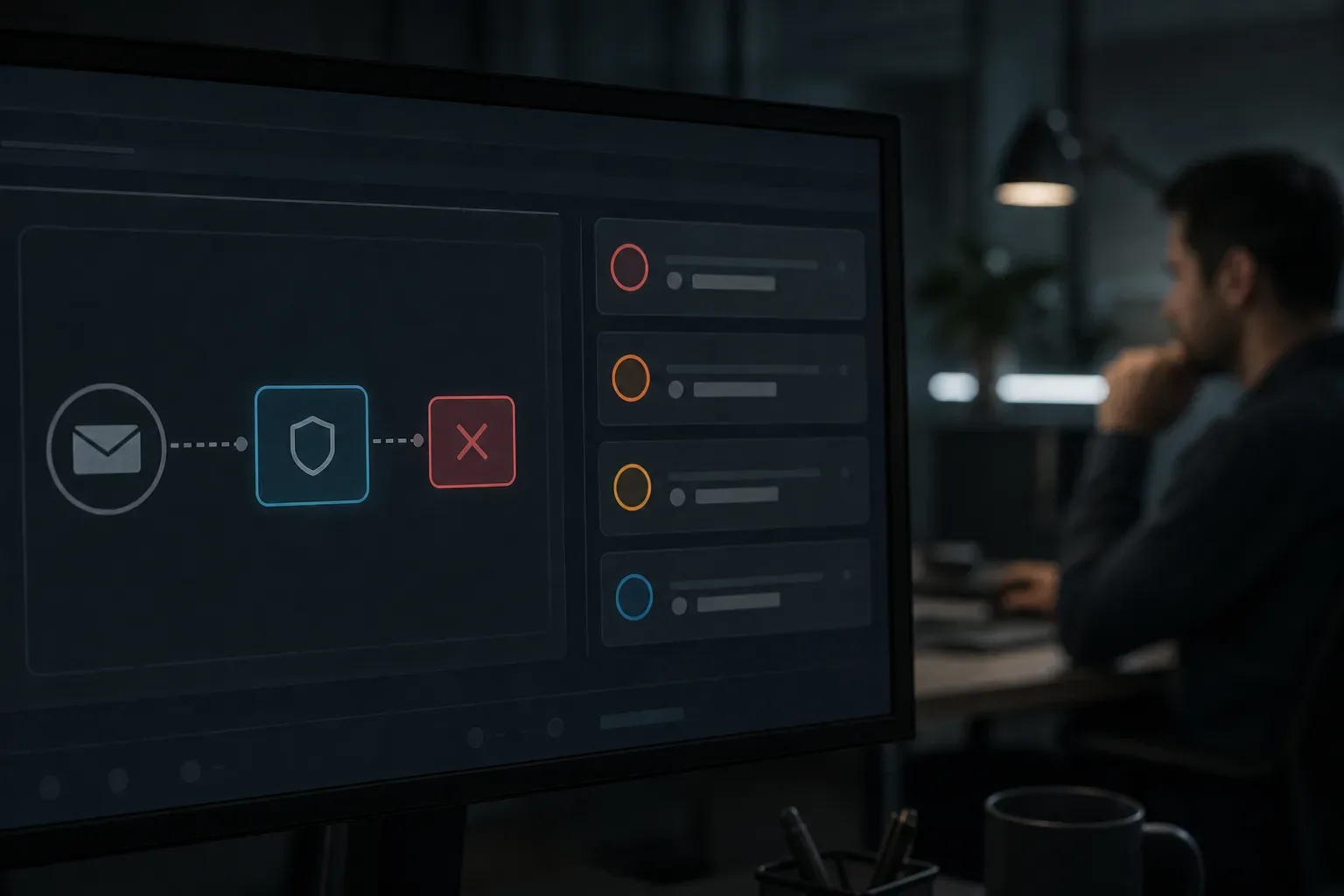
The classifier receives a description of the planned action, such as "delete all files older than 30 days in the shared drive," and assigns it to one or more predefined categories. Those categories might include things like "irreversible," "high-blast-radius," "sends external communication," or "safe to proceed." Based on the resulting category, the system either allows the action, flags it for human review, or blocks it outright.
This is meaningfully different from content moderation. Speed still matters, but so does precision, because a false positive here means the agent stops unnecessarily, and a false negative means a real-world consequence you cannot easily undo.

Why Agents Need a Different Approach to Safety
A standard chatbot producing a bad reply is embarrassing. An agent executing a bad action can delete data, charge a credit card, or send a mass email to thousands of contacts. The asymmetry in consequence is why agent safety requires a dedicated classification layer rather than relying on the underlying language model to self-police.
Large language models are capable of reasoning about harm, but prompting one for every proposed action is slow and expensive. Dedicated classifiers are generally faster and cheaper to run at scale than prompting a large language model for the same binary or multi-class decision. Running a lightweight classification model typically costs an order of magnitude less per inference than an equivalent LLM API call, and most cloud-hosted text classifiers respond in under 100 milliseconds at standard input lengths. That speed matters when an agent is operating inside a tight workflow loop.
The Role of Confidence Scores
Every classifier produces a confidence score alongside its prediction. A confidence score is a probability value between 0 and 1 indicating how likely the input belongs to a given class. An action description that scores close to 1 on the "irreversible" class should trigger a hard stop or a human approval request. An action scoring low across all risk categories can proceed automatically.
The cutoff that determines which outcome applies is called a threshold. By default, many classifiers use 0.5, but 0.5 is rarely the optimal value for agent safety. Setting the threshold too high lets risky actions slip through; setting it too low creates constant interruptions that make the agent useless. Tuning that number against real agent logs is one of the most practical steps a team can take after initial deployment.
How the Classification Layer Is Built
Most action classifiers for agents are text classifiers trained on descriptions of agent actions, labeled by risk level. Building a reliable one from scratch typically costs $5,000–$50,000 or more for a supervised project that includes data labeling, training, evaluation, and deployment. The wide range reflects how much data you already have, how complex your action taxonomy is, and where your development team is located.
For teams that cannot justify that investment upfront, managed classifier APIs offer an alternative. Indicative pricing runs $0.50–$5.00 per 1,000 API calls depending on model size, provider, and input length. The trade-off is that a generic API knows nothing about your specific product domain, so you may need to fine-tune or augment it with rule-based checks.
Most supervised text classifiers require at least a few hundred labeled examples per class to achieve reliable performance. If your agent taxonomy has ten action categories, that means collecting and labeling thousands of examples before training begins. Zero-shot and few-shot LLM-based classifiers can operate with fewer examples, which makes them attractive for early-stage projects even if they are more expensive per call.
Multi-Label vs. Multi-Class Classification
Agent action review often calls for multi-label classification: a single action can be assigned two or more labels simultaneously. The action "email the invoice to the client and CC the billing department" might simultaneously receive labels for "external communication" and "financial document," both relevant to different policy rules.
Multi-class classification, by contrast, assigns exactly one label from three or more possible classes. That works well for simple routing decisions but can miss compounding risks. Choosing the right approach depends on how your policy rules are structured and whether a single action can violate multiple policies at once.
Practical Design Choices
Four decisions shape how well an action guardrail performs in production.
Action description quality. The classifier can only work with what it receives. A vague description like "update records" gives the model far less signal than "overwrite all customer records in the production database with values from the staging import." Structuring how your agent serializes planned actions before passing them to the classifier pays dividends immediately.
Scope of review. Decide early whether the guardrail reviews every action or only those above a preliminary risk filter. Reviewing everything adds latency; skipping low-stakes actions requires trusting that your preliminary filter is accurate. Many teams start with full coverage and selectively exempt action types after building confidence in the data.
Human-in-the-loop routing. Not every flagged action should be automatically blocked. A well-designed system routes genuinely ambiguous actions to a human reviewer rather than failing closed every time. The EU AI Act, in force since 2024 with phased obligations running through 2027, specifically requires human oversight for certain high-risk AI classification systems, so this routing layer may also be a compliance requirement depending on your deployment context.
Feedback loops. Every human override, whether approving a blocked action or flagging a passed one, is a labeled training example. Capturing those decisions and feeding them back into classifier retraining is how the system gets more accurate over time rather than drifting as agent behavior evolves.

What Good Looks Like in Practice
A well-tuned action guardrail is mostly invisible. The agent operates at normal speed, routine actions pass through automatically, and genuinely risky actions surface for review without constant false alarms. The practical signal that a system is working is not a low block rate or a high block rate; it is a low rate of surprised users, where surprise means either "I did not expect the agent to stop" or "I did not expect the agent to do that."
Teams that invest in action description quality, threshold tuning, and feedback collection typically see meaningful improvement in classifier accuracy within the first few months of production operation. The classifier learns the texture of your specific agent's behavior, and that specificity is what separates a generic safety layer from one that actually fits your product.

Frequently Asked Questions
What Are Agent Guardrails in Autonomous AI?
Agent guardrails are safety layers, typically implemented as classifiers or rules engines, that inspect an AI agent's planned actions before they execute. They assign each action to risk categories and either allow, flag, or block it based on the result. The goal is to prevent autonomous agents from taking irreversible or high-impact actions without appropriate human review.
Can an AI Agent Block Itself from Taking a Harmful Action?
Not reliably on its own. Large language models can reason about risk, but they are not consistent enough for high-stakes decisions and are expensive to query for every action. A dedicated classifier running as a guardrail outside the agent's own reasoning loop is a more reliable and cost-efficient approach for production systems.
How Do Confidence Scores Work in Action Classification?
A confidence score is a probability value between 0 and 1 that the classifier outputs alongside its predicted category. A score close to 1 on a high-risk class means the model is highly confident the action is dangerous. A threshold, commonly set at 0.5 by default but usually tuned higher for safety-critical decisions, determines whether the action is blocked or allowed to proceed.
How Much Data Do I Need to Train an Action Guardrail Classifier?
Most supervised text classifiers need at least a few hundred labeled examples per class before they perform reliably. If your guardrail has five risk categories, plan for several thousand labeled action descriptions. Zero-shot or few-shot LLM-based classifiers can start with far fewer examples, making them a practical option when labeled data is scarce early in a project.
What Is the Difference Between Multi-label and Multi-class Classification for Agent Guardrails?
Multi-class classification assigns exactly one label to each action from a fixed set of categories. Multi-label classification allows a single action to receive two or more labels at once, which is often more useful for agent guardrails because one action can violate multiple policies simultaneously. Choosing between them depends on how your safety rules are structured.